




How autonomous agents will reshape platform engineering, deployment, and scalability
Agentic AI is the next major workload shift which is driving the next generation of cloud infrastructure. This time, India can build it.
Together, the agentic SaaS layer and the sovereign infrastructure underneath give Indian companies the foundation to compete with the West and with China, in domestic markets first and global markets next. This time, India should be the builder.
Three constraints are loosening at once. AI-augmented engineering has reset the cost of building software. One engineer now delivers in a quarter what 3 engineers used to ship in a year. The senior engineering leaders who built the world’s largest cloud and AI platforms are starting to return to India driven by uncertainty in the US and a maturing domestic ecosystem that now offers hard problems and real capital. And the dominant AI workload is being rebuilt around agents, a category no incumbent yet owns.
Inference workloads dominated AI through 2024: stateless, latency-sensitive, sub-second requests. Agentic workloads dominate from 2025 onward: long-running, stateful, tool-calling, and cost-bursty. The serving stack built for the first has to be re-architected for the second.
The rebuild that follows opens two parallel opportunities for Indian startups: the SaaS layer above the model where agentic applications meet enterprise problems, and the underlying infrastructure layer below that has to be purpose-built for these workloads. Both represent a strong opportunity for India.
The Agentic SaaS Opportunity
The application layer is where AI moves from research to revenue, and Indian SaaS is positioned to capture a large share of it. Five workload categories are in production today.
Voice agents are replacing first-line customer support and collections at scale, with Indian companies like Skit.ai, Vodex, and Bhashini-powered platforms in production across BFSI, telecom, and healthcare. Customer support automation through agents that triage, resolve, and escalate is the default at Freshworks Freddy, Zoho Zia, and Sprinklr. Service and technical support is being rebuilt around agents that read system logs, run diagnostic tools, and resolve incidents, with Indian platforms like Yellow.ai, Atomicwork, and Gnani.ai deploying these capabilities to IT helpdesks, application support, and field operations. Back office automation across invoice processing, expense reconciliation, KYC verification, and vendor onboarding is being rebuilt around agents that work across systems of record. Self-service in HR, procurement, and finance is moving from rule-based chatbots to agents with memory and tool access that close tickets autonomously.
India’s SaaS market is on track to cross $50 billion by 2030, and India runs a sizeable share of the world’s customer support operations. Indian SaaS players like Zoho, Freshworks, Postman, and Razorpay have shipped AI features into enterprise workflows at scale and are now adding agentic flows on the same surface area. Vertical SaaS founders in healthcare, insurance, logistics, public sector, and BFSI are positioned for the same opportunity.
Agent quality scales with the richness of the data the agent can access. For Indian enterprises, that data sits inside regulated systems: banking transactions, patient records, citizen identity, payments. Agentic SaaS built in India must operate on that data without exporting it to foreign platforms. The right path is to build smaller, domain-tuned, multilingual sovereign models inside India for the data-sensitive parts of agent workflows, with frontier base models powering general reasoning. Both run on a sovereign infrastructure foundation. That foundation is the next build.
Building the Infrastructure Foundation
It has to be well-architected, fault-tolerant, and purpose-built for agentic workloads. Three conditions have to come together: the senior systems talent to build it, the sovereign control to run it, and the economics to scale it.
Talent and the Time to Build
India’s top engineering talent for AI infrastructure has historically been concentrated inside the local offices of global hyperscalers and frontier labs. The independent Indian talent pool, outside the large players, is developing but still narrow. The change in supply now comes from a second source: senior engineering leaders who built and operated the world’s largest cloud and AI platforms in the US are returning, driven by visa policy and geopolitical pressure. Combined with the India-resident pool, this modest reverse brain drain is opening a window for Indian teams to assemble at a quality bar that matches global players.
Autonomous agents are changing three architectural assumptions in the cloud stack. Developer platforms become a substrate for both engineers and autonomous actors. Deployment systems become the safety boundary for agent-initiated change, with the default posture moving from human-approved to policy-enforced. Scaling models become multi-dimensional, sized for workloads that burst across compute, cost, and tool throughput at once rather than steady-state load. Small Indian teams that design around these shifts ship platforms in two years that earlier teams took five to deliver.
The economics have moved with the talent. This is the time to build the most performant systems available, solve hard problems with better solutions, and put low cost and existing R&D to work for our advantage. The skill question remains the biggest challenge, but it is changing fast, and we can build a better system.
That is the late mover’s advantage. India can build its own AI orchestration layer that outperforms existing hyperscalers on efficiency and performance, the same way UPI was built on proven payment technology and surpassed the incumbents. The opportunity is to build past the incumbent generation.
Data Sovereignty
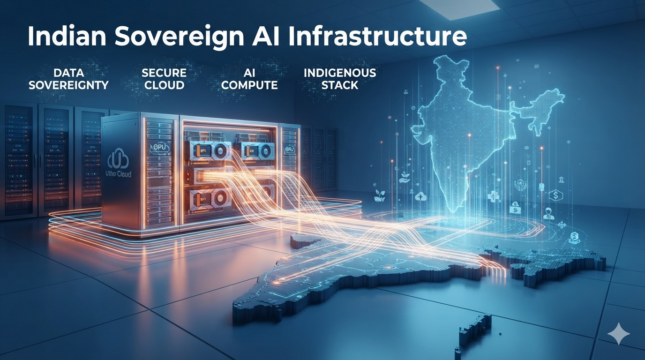
87% of India’s cloud market runs on foreign hyperscalers today. For the fastest growing major economy, with every consumer and enterprise touchpoint moving onto the cloud, that level of concentration is a strategic risk. Critical workloads, regulated data, public-sector training data, and defense-relevant systems should run on infrastructure where the control plane sits in India.
Self-reliance in AI infrastructure means optionality. India decides what to build, partner on, and procure on; without being constrained by the priorities, policies or pricing of foreign hyperscalers. A sovereign Indian platform that holds the data, runs inference, and operates the agents must be built to comply with Indian regulatory requirements from the ground u
Economics & Scale
India’s GPU compute is fragmented across Sarvam, Neysa, Yotta, AIRAWAT, and a few DC operators, each operating independently with no shared access layer, no common API and no unified pool. . No single pocket is large enough to train a serious foundation model or serve inference at global scale. Two complementary builds bring it to scale. The first is the Indian hyperscaler: a domestic provider delivering hyperscaler-grade reliability, security, and economics for India’s strategic AI workloads. The second is a fault-tolerant distributed cloud fabric that federates the existing pockets into a single addressable national pool, with a managed services layer above for training, inference, orchestration, and observability, providing the same primitives developers expect from AWS and Azure. The same fabric serves Indian SaaS founders, academic researchers, SMEs, and state governments from one pool.
The Path Forward
Agentic AI is moving from research to production. The application layer is open to Indian SaaS. So is the infrastructure foundation underneath. The conditions are favourable: talent returning, capital flowing into deep tech, late mover technology choices, and a strategic need for sovereign capability. Together, the agentic SaaS layer and the sovereign infrastructure underneath give Indian companies the foundation to compete with the West and with China, in domestic markets first and global markets next. This time, India should be the builder.

Guest author Vishal Sirohi, CEO and Co-Founder, Island Computing, an Indian fully managed sovereign AI infrastructure – built for the next generation of SaaS, Agentic, and Inference workloads. Any opinions expressed in this article are strictly those of the author.