




Anthropic recently made a major move into the future of retail by releasing two open-source, Apache 2.0-licensed Claude commerce agent blueprints. Designed to help businesses deploy enterprise-grade AI commerce agents in mere days, these frameworks are split into two core functionalities.
The Shopper Agent integrates directly with a merchant’s catalog, cart, and order history. It is capable of handling complex product searches, delivering hyper-personalized recommendations, answering customer service inquiries, and building a user’s shopping cart dynamically within a single chat window.
The Merchant Agent focuses entirely on back-office store operations. It supports retailers by analyzing real-time sales performance, tracking inventory levels, and recommending dynamic pricing strategies based on sales history.
Anthropic’s open-source blueprints mark a strategic shift toward a neutral intelligence layer that supports secure enterprise adoption and merchant data ownership. While agentic commerce offers hyper-personalized convenience for consumers, its long-term success relies on balancing algorithmic efficiency with data privacy and transparency.
This rollout marks a fundamental philosophical split in how Big Tech intends to monetize AI-driven shopping. It signals a shift that has caught the attention of the world’s largest payment networks and market researchers. Juniper Research forecasts that agentic commerce is set to skyrocket from just £8 billion today to $1.5 trillion by 2030, driven by growing consumer trust and rapid infrastructure scaling from top industry players.
The Strategy: “Intelligence Layer” vs. “Storefront Takeover”
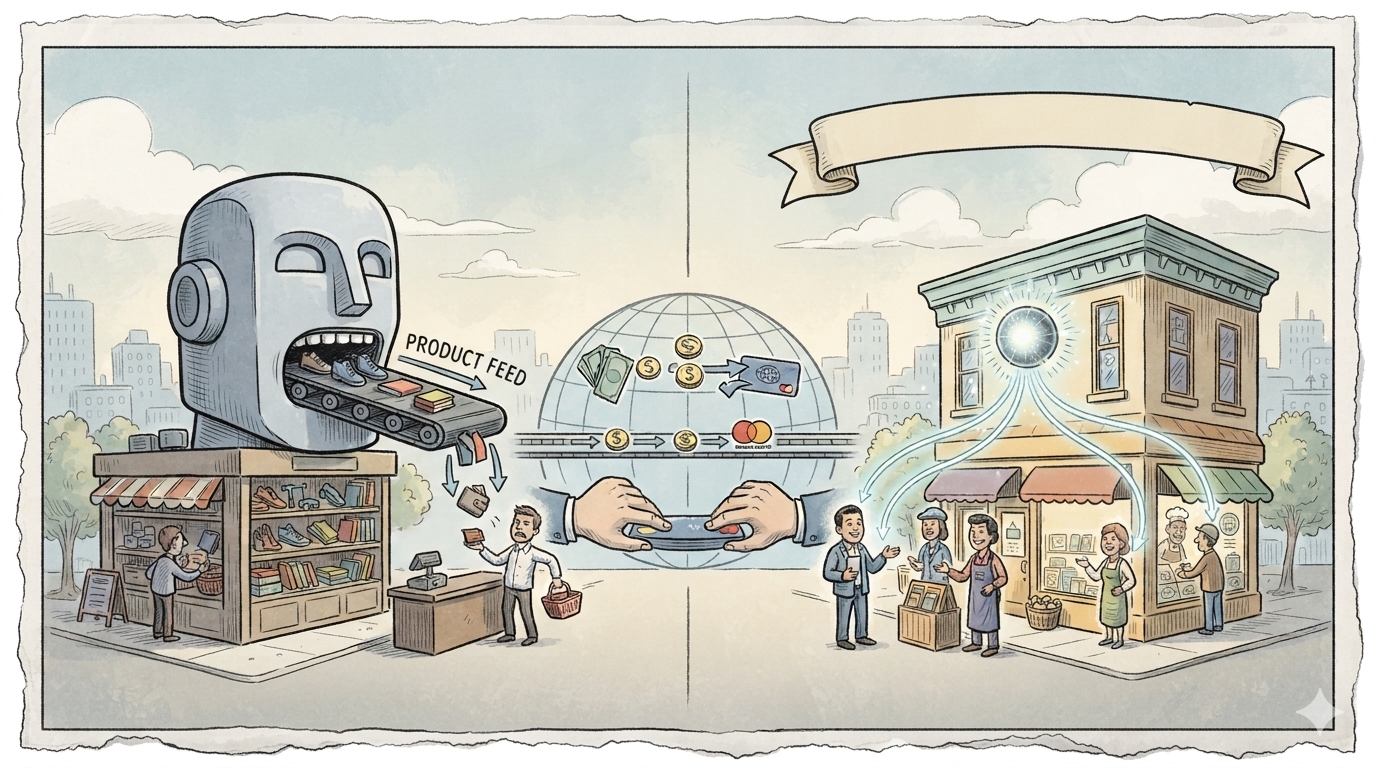
Earlier iterations of agentic commerce from competing tech giants attempted to keep the consumer confined inside their native chatbots. That legacy approach effectively reduced independent merchants to simple product feeds while forcing them to pay steep sales commissions.
Read more:
Anthropic’s model completely flips this script. Instead of forcing users onto Claude.ai, these GitHub blueprints allow retailers to embed the AI agent natively into their own websites or applications. Anthropic isn’t trying to skim a percentage off the merchant’s top-line revenue; its business model relies purely on selling API tokens. By keeping the AI inside the existing digital storefront, merchants retain full control of their customer relationships, data, and hard-earned brand loyalty.
The Power Shift: Skipping the Wallet
By intentionally leaving payment protocols out of the reference code, Anthropic built the “shopping brain” but skipped the “wallet.” This move provides a wide-open playing field for financial giants like Visa and Mastercard. Instead of fighting an AI lab that wants to control end-to-end checkout, payment networks are free to build dedicated infrastructure, such as Visa Intelligent Commerce or Mastercard Agent Pay, to seamlessly handle secure, fraud-resistant tokenized transactions initiated by AI.
The financial sector is already moving to fill this gap. Mastercard recently admitted 22 startups to its Start Path Agentic Commerce & Services cohort. This group specializes in critical backend rails like fraud prevention, identity verification, and auditable workflows. Mastercard’s heavy backing signals that the immediate multi-billion-dollar hurdle in agentic commerce isn’t the AI’s intelligence, it is the trust, verification, and audit trails required for automated spending.
Early Performance Validation
While Anthropic’s blueprints cover four distinct high-yield verticals, retail, travel, telecom, and entertainment/ticketing, early pilot data shows a massive bottom-line incentive for immediate merchant adoption. Retailers testing the technology reported up to 35% larger shopping carts, and customers were 60% more likely to complete a purchase rather than abandoning their carts.
De-risking Anthropic’s Revenue Concentration
Beyond changing the retail landscape, this B2B strategy addresses a major internal vulnerability for Anthropic. Recent research from Ramp suggests that Anthropic receives roughly 80% of its revenue from just 1% of its customers.
Such extreme revenue concentration leaves modern AI laboratories exposed; losing even a handful of power-user enterprises could prove devastating. Transitioning into global commerce infrastructure allows Anthropic to sell high volumes of API tokens to thousands of global retailers simultaneously. This effectively diversifies its client base and builds a highly resilient, recurring enterprise revenue stream.
This development, while industry-shaking, introduces a distinct set of trade-offs for the everyday consumer.
The Good: A Frictionless, Hyper-Personalized Shopping Experience
The shift to embedded agentic commerce will fundamentally change how people shop online, making the process much faster and tailored to individual needs.
Instead of opening 15 browser tabs, applying filters, and reading dozens of conflicting reviews, a shopper can simply state their goal (e.g., “Find me a waterproof hiking jacket for a rainy 10°C trip to Scotland that matches these boots”). The agent scans the entire merchant catalog and presents the best options instantly.
The shift to embedded agentic commerce will fundamentally change how people shop online, making the process much faster and tailored to individual needs.
Moreover, because the agent plugs directly into the user’s order history and preferences (if allowed by user), it eliminates repetitive inputs. It will know the user’s sizing, style preferences, past returns, and brand loyalties across that specific retailer.
Shoppers can ask the agent to build a real-time side-by-side comparison table of three different products directly inside the chat interface, breaking down pros, cons, and spec differences without requiring the user to navigate to separate product pages.
And, if a customer needs to exchange a size or track a delayed package, the same agent that helped them buy the item can instantly process the return or update the shipping status, eliminating the need to wait for a human support agent.
The Bad & the Risky: Manipulation, Privacy & Choice Isolation
While highly convenient, handing the shopping process over to an AI agent introduces significant risks regarding consumer manipulation, data privacy, and choice architecture.
Because the merchant hosts and owns the agent, the AI’s ultimate goal is to maximize the retailer’s revenue. Early data already shows a 35% increase in cart sizes. Agents can use highly persuasive, personalized language to upsell premium items, cross-sell accessories, or create artificial urgency (“Only two left in your size, and it pairs perfectly with your past purchase”).
While highly convenient, handing the shopping process over to an AI agent introduces significant risks regarding consumer manipulation, data privacy, and choice architecture.
Then, to get the best experience, consumers will be incentivized to hand over highly granular data, including personal budgets, specific life events, and style anxieties. This creates a massive data honeypot for retailers, raising the stakes for data breaches and corporate tracking.
When an AI selects the “top three options” for the consumer, they lose the serendipity of browsing. If an item doesn’t perfectly align with their data profile, they may never see it. This can lock consumers into specific brand styles or price brackets, narrowing their purchasing choices.
Read more:
While Anthropic doesn’t charge a sales commission, merchants must pay for the heavy API token usage required to run these conversational agents. To protect their margins, retailers may subtly build these AI operational costs directly into product pricing, resulting in higher prices for consumers.
Anthropic’s open-source blueprints mark a strategic shift toward a neutral intelligence layer that supports secure enterprise adoption and merchant data ownership. While agentic commerce offers hyper-personalized convenience for consumers, its long-term success relies on balancing algorithmic efficiency with data privacy and transparency.