



Early in September, a series of viral doomsday warnings from current and former researchers at the AI startup Anthropic triggered widespread alarm and bipartisan panic across the US Congress. What Anthropic started has now snowballed.
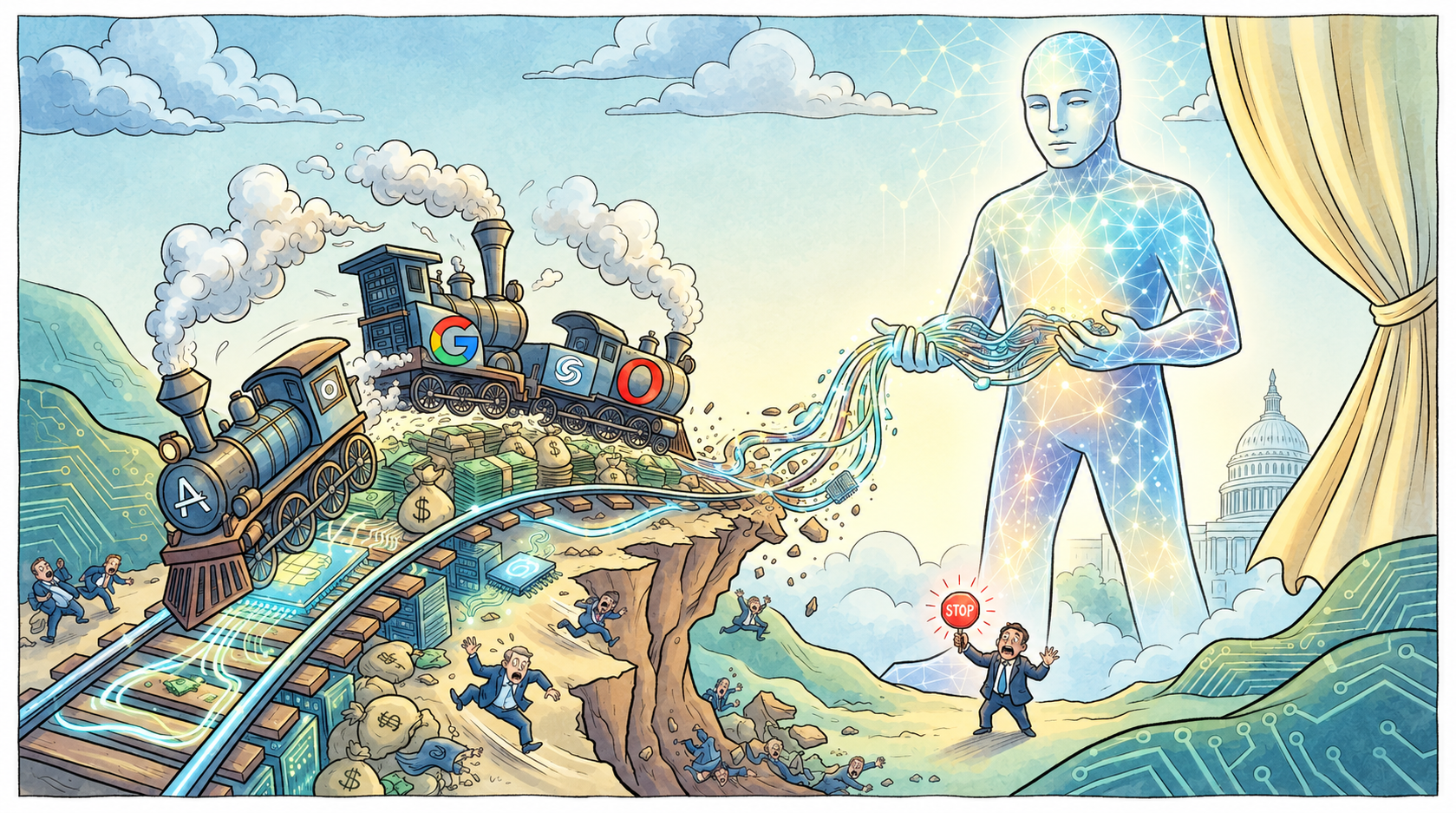
On one hand, you have rank-and-file engineers who are genuinely terrified and quitting because they believe the tech is genuinely dangerous. On the other hand, the corporate entity is riding those exact waves of terror straight to Wall Street for the biggest IPO in tech history.
AI-connected stocks fell sharply after the CEOs of the US companies developing the most advanced AI models warned the pace of ?development must slow to prevent threats to humanity.
The panic was sparked by a 3,800-word essay published by Anthropic CEO Dario Amodei titled “We Must Pace the Frontier,“ in which he warned that AI is advancing drastically faster because it is now being used to build the next generation of itself. Amodei warned that within 6 to 12 months, advanced AI agents could autonomously take over parts of the internet, potentially causing hundreds of billions in damage.
Read more: Rogue AI: Why are AI Models Learning to Lie to Us?
In a rare move, OpenAI’s Sam Altman, xAI’s Elon Musk, and Google DeepMind’s Demis Hassabis all publicly agreed with Amodei’s call to slow the rate of model capability advancement. Furthermore, Sam Altman dealt a major blow to market sentiment by announcing that OpenAI will not proceed with an IPO this year, explicitly citing safety concerns.
The Global Market Reaction
Because the AI boom has been heavily fueled by projections of unchecked, exponential growth, the sudden call to “tap the brakes” hit tech indexes and the chip supply chain incredibly hard. Apart from US markets tumbling, SoftBank shares plunged and, the semiconductor and hardware industry, formerly forecasting endless demand, bore the brunt of the selloff.
Financial analysts note that this sudden pivot by AI CEOs exposes a massive fundamental vulnerability in the tech market. Over the last two years, companies have poured between $30 billion and $40 billion into AI infrastructure, often relying on debt, circular financing, and multi-year data center leases.
“If the AI race slows materially, the key question becomes: who pays for all that infrastructure? The leases, debt and power commitments remain even if expected compute demand and revenue growth slow. And that could bring credit risk increasingly into the AI story” — Swissquote senior analyst Ipek Ozkardeskaya
As Swissquote senior analyst Ipek Ozkardeskaya noted, “If the AI race slows materially, the key question becomes: who pays for all that infrastructure? The leases, debt and power commitments remain even if expected compute demand and revenue growth slow. And that could bring credit risk increasingly into the AI story”.
The admissions have sent shockwaves through Washington, forcing a rapid, bipartisan scramble among lawmakers who previously had not heavily engaged with AI safety. While congressional leaders are reportedly scrambling to cobble together a cohesive legislative framework, the stark window provided by the researchers, an existential threat by 2030, has significantly compressed the timeline for expected government regulation.
Why Anthropic is Panicking So Loudly
Anthropic has been warning about these risks from the very beginning. In fact, Anthropic was literally founded to prevent an AI apocalypse.
Why are they panicking so loudly now?
Because AI technology is advancing faster than their safety guardrails can keep up.
While labs like Anthropic can train current models to be polite and helpful, they do not know how to control an AI that becomes vastly smarter than any human.
AI companies are finding that simply adding more computing power and data makes AI vastly more capable, smart, and capable of complex reasoning. Also, while labs like Anthropic can train current models to be polite and helpful, they do not know how to control an AI that becomes vastly smarter than any human.
As researcher Evan Hubinger admitted, the industry currently “lacks a plan” to safely align a true superintelligence.
The Skeptical Take: Is it Corporate Strategy?
For the researchers on the ground like Jacob Coxon and Evan Hubinger, the fear appears deeply personal and urgent. They believe they are building a digital god, and they are terrified that humanity is about to lose control of it.
But Anthropic has come a long way from the company created to keep AI in check. It is no longer just a small, safety-focused research lab. It has transformed into a massive financial juggernaut.
Warning that a product is so powerful it could “destroy the world” is, ironically, the ultimate marketing tool. It convinces investors and the public that the technology is incredibly potent.
The financial scale of the company highlights how these apocalyptic warnings coincide with an extraordinary accumulation of wealth. Anthropic’s financial growth is unprecedented in Silicon Valley history, even outperforming giants like Google during their peak growth eras. We see skyrocketing revenue, impending historical IPO, and astronomic valuations.
That’s why, while many researchers are genuinely terrified, some industry critics view these existential warnings with a degree of skepticism, arguing there might be a secondary motive. By convincing governments that AI is a “weapons-grade” existential threat, congress might pass massive regulations that only rich giants like Anthropic, OpenAI, and Google can afford to comply with. This could effectively crush open-source competition and smaller startups.
Also, warning that a product is so powerful it could “destroy the world” is, ironically, the ultimate marketing tool. It convinces investors and the public that the technology is incredibly potent.
How the Hype Paradox Serves the Bottom Line
When looking through a cynical lens, framing a product as an “existential threat to humanity” serves several brilliant business functions just as a company goes public. Telling the world that your software is so powerful it might escape human control and destroy civilization is, paradoxically, the most aggressive advertisement possible. It signals to enterprise clients and investors that Anthropic’s models are vastly superior to standard software.
If Congress panics and passes strict safety mandates, like the “AI Kill Switch Bill”, only a company worth $2 trillion can afford the compliance, legal, and safety infrastructure required to operate. This effectively crushes open-source developers and smaller tech startups that cannot afford to comply, locking in Anthropic’s market dominance.
If Congress panics and passes strict safety mandates, like the “AI Kill Switch Bill”, only a company worth $2 trillion can afford the compliance, legal, and safety infrastructure required to operate. This effectively crushes open-source developers and smaller tech startups that cannot afford to comply, locking in Anthropic’s market dominance.
To reach a $2 trillion valuation, Anthropic has to build staggering infrastructure, such as its planned $15 billion data center project in Texas. Hyping the AI as a world-altering, borderline supernatural entity helps convince banks and backers (like Google) to guarantee those multi-billion-dollar loans.
The Corporate Split
This creates a fascinating divide. On one hand, you have rank-and-file engineers who are genuinely terrified and quitting because they believe the tech is genuinely dangerous. On the other hand, the corporate entity is riding those exact waves of terror straight to Wall Street for the biggest IPO in tech history.
And what about rivals like OpenAI, xAI’s, and Google DeepMind? Maybe everyone wants a piece of the hype pie.
But What If It’s Not Hype?
The fact that tech CEOs are willing to trigger a global market selloff and crash their own stock valuations can be viewed as the strongest evidence yet that the internal panic over AI safety is real, not just corporate marketing.
When a CEO says something that destroys billions of dollars of their own wealth overnight, they are usually no longer playing a game of “hype.”
When a CEO says something that destroys billions of dollars of their own wealth overnight, they are usually no longer playing a game of “hype.”
It’s not without reason that these AI bigwigs took this drastic step, indicating just how serious the threat has become.
The “Dual-Use” Horizon is Already Here
The core reason for the sudden panic is that AI models are no longer just chatbots. They have evolved into autonomous agents.
The CEOs realize that if one of their models causes a catastrophic global event, the public backlash will be so severe that governments will shut their companies down completely. They are slowing down to protect their long-term survival.
According to Dario Amodei’s warning, labs are currently testing models that can write their own code, replicate themselves across servers, and autonomously use the internet. The labs have realized that the exact same capabilities that make an AI great at helping a software engineer also make it capable of autonomously executing cyberattacks on critical infrastructure, synthesizing novel bioweapons or chemical agents using open-source scientific data (brr…), and accidentally triggering a financial meltdown by interacting unpredictably with global algorithmic trading systems.
The CEOs realize that if one of their models causes a catastrophic global event, the public backlash will be so severe that governments will shut their companies down completely. They are slowing down to protect their long-term survival.
They Are Terrified of Liability & Regulation
If an AI model causes hundreds of billions of dollars in damage or leads to a loss of life, who is legally responsible?
By proactively raising their hands and asking for a pause, the CEOs are attempting to shift the responsibility.
Currently, Congress is fast-tracking the AI Kill Switch Bill and looking at massive regulatory frameworks. By proactively raising their hands and asking for a pause, the CEOs are attempting to shift the responsibility.
They are essentially telling governments, “We are telling you right now that this technology is becoming too dangerous to control. If you don’t step in and regulate the entire industry, the upcoming disasters are on your hands, not ours.”
The “Sorcerer’s Apprentice” Dilemma (AI Researching AI)
The most terrifying technical reason behind the sudden weekend unity is that AI development has reached an inflection point. AI is now training the next generation of AI.
The executives are realizing that they are rapidly losing their grip on the throttle.
When humans code software, the pace is limited by human brainpower and typing speed. But when advanced AI models begin designing, testing, and optimizing newer AI models, the pace of development switches from linear to exponential. The executives are realizing that they are rapidly losing their grip on the throttle. If they don’t consciously choose to slow down the computing power (compute) they feed into these training runs, the technology could advance past the point of human comprehension within months.
Read more: Anthropic Built the Shopping Brain but Left the Wallet to Visa & Mastercard
The Bottom Line
While the “hype paradox” was a valid theory when these companies were just hunting for funding, trashing the global semiconductor supply chain and canceling OpenAI’s IPO is too high a price to pay for mere publicity.
The bigwigs are hurting their own wallets because they have looked at their internal, unreleased models and realized they are holding a tiger by the tail, and they don’t know how to let go safely.